
 |
Capital: Rome Currency: Euro Population: 58.1 million Food: Pizza, pasta Drink: Morning espresso |
Italy is right up there with France as one of those classic cycling destinations.
There are so many areas to explore and each one has its own flavour. From the German-speaking areas in the north to the beach resorts on the Adriatic, from the heart-pumping Dolomite mountains to more relaxed pedalling around the flat rice fields of the Po River Delta, there really is something for everyone.
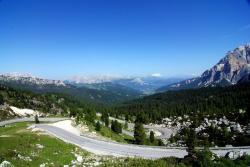 Wherever you go in Italy, one thing is guaranteed: fantastic food, coffee and wine. Staying well nourished in Italy is a cyclist’s delight with so many good pizzas and pastas to choose from, followed up by a cold gelato for desert.
Our journey took us from Briancon in France, over the Col de Montgenevre and into Pinerolo. From there, we cycled through corn and rice fields to Pavia, before turning north through Milan and up the side of Lake Garda. There we joined a marvellous cycle path all the way to Bolzano and across to the Dolomite mountains of northern Italy briefly in early summer 2007. Then, after going through eastern Europe, we returned to Italy from Austria in August. From the largely German-speaking area of Trentino Alto Adige we rode all the way down the Adriatic coast to just south of Ancona and the very traditional area of Le Marche.
Our Italian ‘Must Pedal’ List
1. Dolomite mountains
2. Via Claudia cycle path
3. Ancona to Portonovo
4. Le Marche
5. Ravenna and Verona, gorgeous cities
And to avoid…
1. Adriatic coastline in August
2. Expensive Lake Garda and its busy roads
3. Po Delta during hot weather
 GOOD ROADS, FREE MAPS
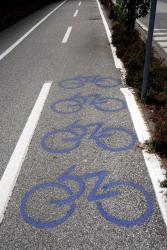
Italian roads are in good shape but it’s sometimes difficult to find low-traffic routes. Even roads that looked to be secondary routes on our map sometimes turned out to be filled with bumper-to-bumper cars and heavy trucks. There are a few cycle paths around, notably the Via Claudia which is signed all the way to Verona and a dedicated cycle path for almost the entire distance from the Austrian-Italian border to just south of Trento. On the Adriatic coast the traffic was heavy but there were good shoulders for most of the way. We were travelling in the peak holiday season so off-season cycling might be more tranquil.
We used free maps from tourist bureaus for the first few days. In Milan we picked up a 1:300 000 atlas covering northern Italy, Switzerland, Austria, Slovenia, Croatia and parts of France. It also has helpful larger scale maps of Europe and Turkey. Campsites are marked, helpfully quite close to their actual locations (not just as a general sign next to a town name, as Michelin maps mark campsites). The map is published by Studio F.M.B. Bologna. We also had the Lonely Planet cycling guide to Italy, which gave good ideas for routes but is now a bit outdated in terms of prices since it was published in 2003.
CASH SPLASH
What we didn’t like about Italy was the price. We were frustrated by expensive campgrounds, hotels that rarely if ever had rooms for less than 75 euros a night and internet access costing up to 9 euros an hour! Only coffee made us smile as it was possible to find a good espresso or cappuccino for just over a euro. A meal in a pizza restaurant would run about 15 euros a person. Self-catering is a must if you want to do Italy on a budget. We also had a few experiences with tourist bureaus who maintained it was “impossible” to get places by bike.
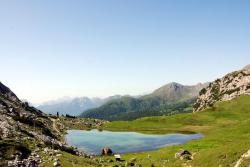
Finding water was another concern. Water fountains in the Alps coming over from France didn’t seem to be as common as in other parts of Europe. We had an almost daily hunt for water. Tourist bureaus often offered to fill our bottles from their private bathrooms, however we had to time our visits with their slightly irregular hours! A water filter would be handy in the mountains, when you also need to take extra water for the climbs and stock up on food too, especially if you are travelling outside the peak months of July and August. We found many businesses closed and towns deserted in June in the Alps and Dolomites.
Although wild camping is illegal in Italy, we camped without problems a few times. This was easiest in the mountains and we also had luck camping behind the numerous chapels alongside the road. Campgrounds are only common in the very touristy areas like Lake Garda and like everything else in Italy they are pricey. Count on 15-30 euros for a tent and two people, depending on the season and area.