•   
  •   
  •   
 

You Are Viewing Britain

John O’Groats To Land’s End: The Traffic-Free Way

Posted June 19th, 2012

Every year, hundreds of cyclists set out to bike the distance between the northern tip of the United Kingdom – John O’Groats – and the southern point of Land’s End.

The trip – often referred to as LEJOG or JOGLE, depending on direction – is about 1,500km long. It’s a great distance for a bike tour of anywhere up to a month (depending on your appetite for mileage) but not everyone makes this trip on the most quiet of roads.

There are alternatives, however, including one route that British cyclist David Piper created. It goes from end-to-end across Britain, on quiet country roads and bike paths. He took a few minutes to tell us about it. You can also view the GPS track, which we created from David’s map.

***

Why did you create this route?

I live close enough to Land’s End to see streams of ‘End to Enders’ trudging up the A30 dual carriageway in the summer. While they’re fighting traffic and slashing their tyres on the broken glass littering the scant shoulder, I’m slashing my wrists in despair at their lack of imagination and planning.

I assume they have plotted the rest of the route in much the same manner when (with a little time invested) they could have taken the road less travelled along the blissful B-roads and scenic cycle tracks that criss-cross our green and pleasant land.

I’d been asked by the anti human-trafficking charity Bringing Freedom to plot such a route and I was so pleased with the results I thought I’d share it with you!

John O'Groats to Land's End (traffic free)
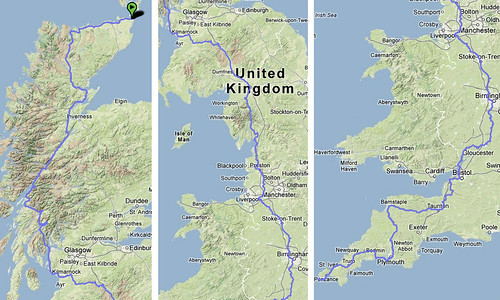
A rough outline of the route. Click for a bigger version on Flickr.

How did you map out this particular route? 

I wanted to use as many of the Sustrans National Cycle Network (NCN) routes as possible, and traffic-free roads wherever possible.

Scotland really stood out in this respect. It was a cyclist’s dream of empty roads, fabulous mountain-scapes and enough bird and wildlife to keep any budding David Attenborough happy. We saw lapwings and ospreys.

In the far north, we could even use some main roads. It’s wilderness up there, and we saw more wild deer than wild drivers!

Can you give us a quick summary?

Sure!

We started in John O’Groats. From there, we climbed over rolling moorland south of Beauly and dropped down to Loch Ness. We braved the A82 to the quaint town of Fort Augustus but on reflection it would have been far better to pick up the tiny road (NCN 78) that follows the southern bank of the lake.

Land's End To John O'Groats

We then went off-road, beside the Caledonian Canal. We rode past snow-capped Ben Nevis to Fort William, then south of Loch Leven on  parts of the old railway (NCN 78). Next we detoured around Loch Awe past the Falls of Cruachan and the underground hydro-electric plant pumping out millions of watts of clean, renewable energy. Hidden, silent valleys beside Loch Eck took us through the Argyll Forest to the Dunoon Ferry.

Next it was on to B743 and a handful of unclassified lanes. These took us east over the bleak and desolate Southern Uplands to Abingdon – Scotland’s highest village. From here, the NCN 74 uses a deserted road all the way to Gretna Green – where eloping lovers could once be wed.

Land's End To John O'Groats

We climbed into the Lake District on the B5299 (NCN 7) to Caldbeck, then south on Pasture Lane to the utterly beautiful Ullswater before tackling the only real mountain in the whole trip – the Kirkstone Pass, descending to the touristy waters of Windermere.

Land's End To John O'Groats

NCN 55 & NCN 5 took us most of the way from Preston to Worcester through the heart of England’s Industrial Revolution on miles of canal paths. Then it was on to the old railtrack NCN42. We were disappointed that only a little of this was complete but soon it will be a grand route from Cheltenham to Welsh Chepstow.

Bristol is the home of Sustrans so a traffic free route into the city wasn’t hard to find. It took us out again over Brunel’s iconic Clifton Suspension Bridge and later on the Strawberry Line (NCN26), heading south to the gorgeous gorge of Cheddar.

Land's End To John O'Groats

In Somerset, we traced a canal from Bridgewater to Taunton, followed by the B3227 for the 50 miles between Taunton and Barnstaple. Next it was the NCN27 Devon Coast to Coast route, making sure we stopped at the legendary Yarde Café for a pint of homemade cider.

Now in Plymouth, we crossed into Cornwall and rode the magnificent coastal road along Whitsand Bay, hugging the coast until Looe before following the river valley to Liskeard. A short blast along the A38 was unavoidable but we soon got on unclassified roads that trace the new A30 as far as Fraddon.

From there, the B3275 follows the Ladock Valley toward Truro. Cornwall’s tin mining heritage was evident along the coast-to-coast cycleway from Devoran to Portreath. From there, we were treated to a fabulous run along the North Cliffs on B3301. Finally, it was NCN 3 all the way to Land’s End.

What were some of your favourite parts of the trip?

In Scotland, we briefly followed NCN 78. It’s part of an old railway line and in a few years it should connect Oban with Loch Ness. It hugs the stunning coastline and is quite possibly the best cycle track I’ve ever ridden!

I also loved the area around Preston and Worcester. You ride through the heart of England’s Industrial Revolution on flat, pretty and traffic free canal paths. And don’t forget the added benefit of a smattering of lock-side pubs! Willows wept and otters leapt, whilst happy holiday-makers waved cheerily from their converted barges. Fantastic.

Land's End To John O'Groats

Did you ever need off-road tires?

Not really. We first went off-road beside the Caledonian Canal but the surface was fine grit so our standard road tyres could cope with it. This was also the case with the other unpaved sections nationwide.

Isn’t your version of JOGLE a little long?

Our total route was about 2,000km but so what if it took a little longer? That’s the whole point, isn’t it? If you want to sprint up the highway, the record is under two days, so knock yourself out! Or maybe the traffic will first…

More info:

Cycling The West Highland Way

Posted December 18th, 2010

why1.jpgThe West Highland Way is a 154km trail that runs from the outskirts of the Scottish city of Glasgow to Fort William, at the foot of Ben Nevis mountain.

It’s well known as a walking path but you can also bike along the route, which is exactly what David Piper did in November. In this guest post, he tells us about the experience and gives some tips in case you want to cycle the same path.

***

I wiped another snotsicle from my nose and, through the mist of my breath, stood back to admire the bonnie banks of Loch Lomond. I’d been following the West Highland Way northwards and was now about to ride the 24-mile eastern shore of Great Britain’s largest freshwater lake that makes up about a quarter of the West Highland Way. To describe the scenery I could write a book of clichés so bad you would want to poke out your mind’s eye, but clichés wouldn’t be clichés if they weren’t true, so I’ll let the pictures paint the words.

West Highland Way

Swathed in layers of merino wool and lycra, I set out into sub-zero pine forests north of Glasgow feeling like Bibendum’s chubby cousin but I soon worked up a sweat. I’d found a perfect weather window as, travelling over frozen ground I’d stay dry and clean. With well over 100 inches of rain each year, the Western Highlands are one of the wettest places on earth, but the previous week had been dry so it looked like I might just be able to have my cake and eat it too. A sprinkling of snow could only add the frosting to my all-you-can-eat cake buffet. This is a popular route with walkers in summer but here, in the bleak mid-winter, barely a handful of hardy hikers were out. When a luminous yellow puffing apparition whizzed by they gave me the kind of quizzical look a dog gives a plastic bag caught in a fence on a windy day.

The surprisingly hilly gravel track gave way to a flowing single track which gave way to a boulder strewn footpath toward the northern reaches of the Loch and I had to resort to shouldering the bike for the last five miles, cursing as I scrambled up rocky banks, sliding down between roots and branches, hitting the ground harder than Humpty Dumpty and feeling the chills as darkness spread her cloak around me. Little wonder then, that the fugitive Rob Roy Macgregor hid out in these spooky ancient oak woods, and the thought flickered across my mind that a broken ankle out here could mean spending the night with his ghost. Whhooooooo…

West Highland Way

Finally out of the woods (quite literally) I followed Glen Falloch between the towering peaks of the northern Trossachs to the little town of Crianlarich, that provided a welcome opportunity for some hot food, and then climbed steadily to Tyndrum and Bridge of Orchy. The Way was out in the highlands proper now with the scenery becoming ever more dramatic at every turn. Frosty valleys between the snowy mountains and not a soul to be seen. Heaven had frozen over.

The track wound through pines about Loch Tulla and then picked up the old drover’s road. It climbed high on to the open wilderness of Rannoch Moor. Bleak and lonely. Wild and barren. It can be a dangerous place but deceptively benign today where, from the cairn at 350 meters, I could enjoy the earthen tones of the Grampian Mountains that surrounded me, and see distant herds of red deer grazing on the heather.

The Glen Coe Ski Centre has the most wonderful café where I packed in the calories and warmed my hands around a mug of steaming cocoa, marvelling at the view of the first of the Three Sisters through the glass wall and defrosting my feet before the roaring log fire. As much as I love biking, I really struggled to tear myself away from that place.

West Highland Way

Satan himself must have been sniggering at my clumsy attempts to ride the Devil’s Staircase, and I’m sure I heard him laugh out loud every time my cleated cycling shoes failed to grip on rock or ice, but within a couple of hours I was heading steadily downhill where the lights of Kinlochleven were twinkling a welcome in the early twilight (although the romantic effect was somewhat spoiled by the floodlit astro-turf pitch!)

It was minus six degrees but I was soon shedding the layers on the short-sharp-shock climb up to the old military road that takes a magnificent high pass toward journey’s end at Fort William. A few inches of fresh snow took the pounding out of the rocky road but hid frozen puddles that had me slipping and sliding like a pole dancing pine marten. Into the last few miles and, as if to provide the perfect grand finale, I was rewarded with a vista of Ben Nevis, with only its 1334m peak (the highest in the UK) shrouded in thick grey snow clouds.

West Highland Way

Top Ten Tips

1. There’s an ample choice of accommodation and camping all along the route, and no need to book ahead except in peak season (June, July & August).

2. Avoid the top half of the east bank of Loch Lomond. In summer you can get a ferry to the west bank from Rowardennan or (if you don’t mind a little pushing & technical single track) Inversnaid, but in winter consider taking the cycle route that follows the A82 from Balloch to Tarbet then either brave the main road for 10 miles or hop on the train for one stop.

3. Use a sturdy mountain bike (not a tourer) and have it serviced before you go.

4. Slightly over-inflate your rear tyre to reduce the risk of pinch flats.

5. Don’t expect to cover too many miles. The energy expenditure of this type of riding is roughly three times that of loaded touring, so divide your usual average daily mileage by three to give an idea of how far you’ll get.

6. Get in shape. You’ll enjoy it a whole lot more if you aren’t gasping for breath.

7. Brush up on your technical skills.

8. Pack light, but do take spare tubes, basic tools and wet weather gear. From May to September take midge repellent and October to April pack for the cold and take lights (mid-winter will only yield 7 hours of daylight). A phone, compass, maps and GPS aren’t essential but are safe precautions.

9. Don’t creep up on wildlife or the hikers.

10. Be prepared for one of the most amazing rides of your life!

Posted in Britain, Guest Posts, Map

We’re leaving, on a jet plane

Posted September 3rd, 2006

Another drink boys?Here we go again!Well, that’s it. After months of planning, weeks of packing, tomorrow we’re off to Gatwick to catch a flight to Canada, where the first leg of our bicycle trip starts. We’ve had a hectic week or so, saying goodbye to many friends, our jobs, clearing out our flat and packing but it’s all done now. All we have to do is start pedalling!

Wedding Weekend

Posted August 15th, 2006

Zaar Get-together
Andrew at the Wedding
Friedel at the Wedding

We went to the marriage of Kevin & Julia on Saturday, one of our last weekends away before the big trip. Andrew met Kevin when they both worked at the FT. It was a lovely afternoon for the wedding, despite starting out a bit rainy. After dancing the night away, we then drove down to Kent for a meet-up with some of Friedel’s friends from the Recipezaar.com (now food.com) website.

Posted in Britain

Shake-Down Weekend

Posted August 9th, 2006

Spin, Friedel, Spin!Andrew eyes up the grapes....A couple weekends ago we did our first trial run fully loaded. We took the train to Ashford and cycled from there to the curling club, near Tonbridge, via the National Cycle Network Route 18. It was quite the challenge for us: a hot day, more hills than we’d expected and the weight of all the gear slowing us down.

Still, we managed a respectable 75km (including getting lost!!) and without a proper lunch too or many breaks. Once at the club we got our tent up and slept very soundly, then were able to fire up the stove in the morning and make ourselves a coffee and porridge. Not bad for a first go!

All in all we were pretty pleased with ourselves. We did learn a few things. Don’t leave your gear in the tent porch because the tent is very attractive to slugs which will crawl all over your stuff! Also, we really needed sleep sacks because our bags stuck to us in the heat. We have since made those out of old sheets. Oh, and we need to make sure we stop for good breaks. I think we would be in danger of exhaustion if we tried to go as hard as we did that day, every day.