•   
  •   
  •   
 

You Are Viewing France

Three Great Bike Touring Routes In Europe

Posted February 4th, 2013

Every February, thousands of cyclists come to Amsterdam for the Fietsenwandelbeurs. It’s a gigantic fair centred on everything of interest for bike tourists, hikers, campers and anyone who enjoys the outdoors.

As part of the event, 3 bike routes are nominated for ‘best bike route of the year’. Here are the 2013 selections.

1. Velodyssey – The Atlantic Cycling Route
The top choice of this year’s judges is Velodyssey: a 1,200km bike route that starts in Britain and runs all the way down the western coast of France to the Spanish border. It’s France’s longest waymarked bike path and connects up neatly with the Eurovelo 6 and Eurovelo 4 routes.

2. Burgundy By Bike (Tour De Bourgogne)
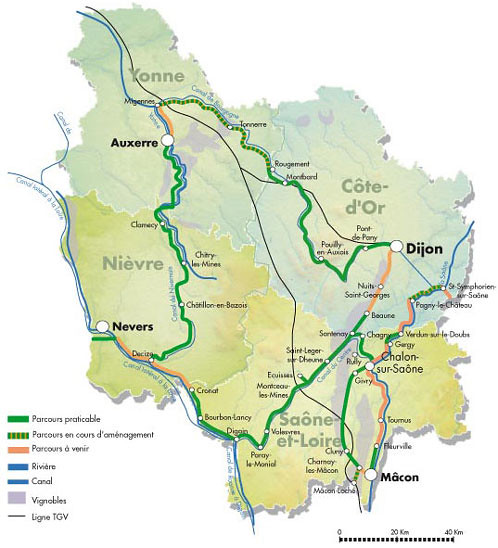
The Tour De Bourgogne sounds like a food-loving cyclists’ dream. It’s a 580km bike route (soon to be expanded to 800km) that passes through the gastronomic capital of Dijon and famous wine regions around Mâcon. The route is set partly along voie vertes, canals and disused railway lines, where no motorised traffic is allowed. Detailed route descriptions and a GPS track are available from the website.

Tour De Bourgogne

#3. The Vennbahn
At just 125km in length, the Vennbahn is the shortest of the three nominated routes. Unless you live nearby, it’s not likely to be a destination in its own right but could make a nice addition to a longer tour. It traces the path of an old railway line through Germany, Belgium and Luxembourg. The website has some good information about the route and the area, including intriguing stories about the coffee smugglers that roamed the border areas of Germany and Belgium after World War II.

Video: Our First Big Family Bike Tour

Posted July 31st, 2012

We just returned from our first extended bike tour as a family. 

With 5-month-old Luke in tow, we cycled 550km through the Netherlands, Belgium and France. We’ll be blogging more in the coming weeks about the lessons learnt from this tour but first, a video that we managed to shoot and assemble (in our tent at night) along the way.

Bike Touring Belgium & France: Our Planning Resources

Posted July 24th, 2012

We’ve just returned from a 2-week bicycle tour though southern Belgium and northern France. Here are some of the resources we used to plan the trip, plus a few thoughts on how it worked out.

Trip Overview: The goal was to cycle 550km from the Netherlands to a small town in northern France, where friends had rented a house for a few days. We hoped to camp most of the way. In terms of sights, we wanted to see:

Leaving the highest beer cafe in the Netherlands

The Route: This was our first bike tour with 5-month-old Luke. Our main priority was to find smooth, quiet roads. We used the following sources:

Putting all of this together, we came up with the route that you see below. It includes a train journey back home. You’re welcome to download the GPS track but beware: it includes all our wrong turns and detours! There’s also this relatively clean pre-trip plan.

How did our trip work out?

Highlights: We definitely achieved our goal of riding only on quiet roads and bike paths. We were often on dedicated bike paths and the roads we did use had very little car traffic. We felt very safe with Luke in tow. We also loved the area around Compiègne in northern France: it’s full of beautiful chateaus, forests and historic sights.

Lowlights: In addition to poor weather (just a matter of bad luck), here’s what we didn’t like so much…

  • Bike paths in Belgium weren’t always up to scratch. Sometimes major paths such as the RAVeL network were little more than a muddy track through the forest, and a poorly maintained one at that. The picture below illustrates our point. On one day, we spent more time walking than cycling. It wasn’t always so bad. Many sections were excellent but the inconsistent quality was frustrating.

Belgium's 'national' Bike Route
Walking and lifting our way along a bike path in Belgium. Photo by Alicia.

  • There’s little to see in southern Belgium. Once we left the Ardennes, we found very little to see other than the countryside. It was surprisingly hard to find supermarkets and other services without detouring to major towns. The whole area felt a little isolated and run down. Finding a nice cafe to have a coffee and a slice of cake seemed like mission impossible. This was very different from the cycling we’ve done in northern Belgium.
  • Coming back by train was a pain. It’s perhaps stating the obvious but getting a fully-loaded touring bike on a train in Europe is often difficult. Bike wagons may or may not exist, often involve lifting your bike up a steep set of stairs and can be crowded in the summer. We managed but only thanks to the help of many other cyclists along the way, and a good sense of humour. We were also lucky that the staff at two stations led us across the tracks to change platforms, rather than making us lug our bikes and gear up and down flights of stairs. We are seriously considering folding bikes (such as the Dahon Speed TR) for future tours of Europe. A reader also suggested that the Bicycle Bus (Fietsbus) would be a good option for journeys to and from the Netherlands.

Conclusion: Not one of our most memorable bike tours, though we are happy to have done it and we particularly enjoyed cycling in France. If we cycle to Paris again, we’ll probably plan a route along the North Sea and then south through France – and we’d get folding bikes for an easy train journey home.

Biking Eurovelo 6: Along Europe’s Rivers

Posted May 11th, 2011

Eurovelo 6 is a 4,000km long bicycle route that runs from the Atlantic Ocean in France to the Black Sea and follows 3 of the largest rivers in Europe: the Loire, Rhine and Danube.

David Piper recently returned from a ride along part of Eurovelo 6. In this guest post, he describes the route and offers tips in case you want to cycle the same path.

***

Perhaps one of the most popular cycle routes in the world is that along the Danube river between Passau and Vienna. It’s so popular that the route now follows both sides of the river to ease the two-wheeled traffic congestion.

What isn’t always appreciated by the people cycling along the Danube is that this is just one section of the Eurovelo 6 (also known as EV6 or VR6) that stretches from the French Atlantic port of Nantes to Constanta on the Romanian Black Sea coast.

Eurovelo 6

Image courtesy of the Eurovelo 6 website

This Easter we rode a 1,000 km section of Eurovelo 6. We started in Basel, Switzerland and rode to Orleans in France. Here are a few key facts from our trip:

1. The route follows inland waterways. It runs along the Rhine-Rhone Canal, The Doubs, The Saone, The Canal du Centre and the River Loire. This means it’s easy to pick up the trail no matter what your starting point.

Continue Reading About Bike Touring Along Eurovelo 6

Cycling Eurovelo 6 From Switzerland To France

Posted May 11th, 2011

Eurovelo 6 is a 4,000km long bicycle route that runs from the Atlantic Ocean in France to the Black Sea and follows 3 of the largest rivers in Europe: the Loire, Rhine and Danube.

David Piper recently returned from a ride along part of Eurovelo 6. In this guest post, he describes the route and offers tips in case you want to cycle the same path.

Eurovelo 6
Photo by gregoriosz (Flickr).

***

Perhaps one of the most popular cycle routes in the world is that along the Danube river between Passau and Vienna. It’s so popular that the route now follows both sides of the river to ease the two-wheeled traffic congestion.

What isn’t always appreciated by the people cycling along the Danube is that this is just one section of the Eurovelo 6 (also known as EV6 or VR6) that stretches from the French Atlantic port of Nantes to Constanta on the Romanian Black Sea coast.

Eurovelo 6

Image courtesy of the Eurovelo 6 website

This Easter we rode a 1,000 km section of Eurovelo 6. We started in Basel, Switzerland and rode to Orleans in France. Here are a few key facts from our trip:

1. The route follows inland waterways. It runs along the Rhine-Rhone Canal, The Doubs, The Saone, The Canal du Centre and the River Loire. This means it’s easy to pick up the trail no matter what your starting point.

2. Following the water also means the route is flat. Although you won’t get any mountain top vistas, it does pass through some fabulous countryside and even traverses the Jura foothills of the Alps without any appreciable climbing.

3. The route is well marked with signs. Still, it’s probably a good idea to invest in a map, such as the EV6 map sold by Sustrans.

4. About 70% of the route is on dedicated traffic free cycle paths. The remainder is on quiet country lanes and 95% of the surface is super-smooth asphalt so you won’t need anything other than a standard road or touring bike.

A beautiful chateau on EV65. You’ll never be more than 10km from a town for food, accommodation and campsites. Usually there’s something to suit all budgets. Whilst France isn’t a cheap place to tour the larger towns on route will have the budget supermarkets such as Lidl and Aldi.

6. The French take their lunch-breaks and holidays seriously. Make sure to stock up on food outside these times. You can tour the route at any time of year as the climate is reasonably benign so it’s probably best to avoid August and the last two weeks of July as accommodation may be fully booked and the trail busy.

7. France is the spiritual home of le velo. Riding a bike is as much a way of life as it is a mode of transport or means of keeping fit. One thing is for sure; you won’t be seen as an eccentric hobo (as is the case in much of the world) when you roll into town clad in luminous spandex.

OtterIt’s hard to imagine a nicer ride really. We passed through thoughtfully preserved mediaeval villages, admired Gothic architecture, saw stunning chateaux and spotted swooping herons and romping otters. Large sections of the Loire valley are protected by UNESCO so are a haven for wildlife.

The food in France speaks for itself and you’ll be hard pressed to find a restaurant that doesn’t take care and pride in the presentation of its dishes. Then we have the wine, of course. The route flows through the wine regions of Alsace, Burgundy, Sancerre and Pouilly. We camped right next to some of the world’s most renowned vineyards on the Côte d’Or and overall, we were spoilt for choice when it came to wine.

Camping on the Côte d'Or

As I was cruising along enjoying the traffic-free bliss it did occur to me that this would be an ideal ‘first time tour’ or perfect for anyone wanting to get their family or even a reluctant partner involved in cycle touring. Perhaps the only downside is that once you’ve ridden it anything else will seem second rate.

***

Thanks to David Piper for his report on Eurovelo 6, and for contributing the photos.

Need more information?